

If you’ve ever told yourself “I’ll start an online business when I finally have time”, this article is for you.
Most people imagine building something online as a huge, complex project that needs months of planning, branding, logos, funnels, a personal rebrand, a new laptop, the right coffee mug… and then another six months of “research”.
Meanwhile, one very simple model keeps quietly working in the background:
- no inventory,
- no shipping,
- no Zoom calls with clients,
- and margins that make e-commerce look like a bad joke.
I’m talking about AI-assisted ebooks – simple PDF guides created with tools like ChatGPT.
And no, this isn’t theory. I’ve used this exact model to create a 52-page AI-assisted ebook in under two hours that went on to generate $96,870 in 90 days. One weekend of focused work, a simple funnel, and a digital file that keeps selling long after the work is done.
In this article I’ll walk you through, step-by-step, how to use ChatGPT to create a profitable ebook in a single weekend – from idea, to outline, to finished product and basic sales setup.
🤝 Why ChatGPT + Ebooks Is the Perfect Weekend Business
Before we get tactical, it’s worth asking: why this model, and why now?
⏳ The problem with “I’ll start someday” side hustles
Most people never start because they think they need:
- the perfect idea,
- weeks of free time,
- or professional writing skills.
So they stay stuck in “prep mode”:
- binge-watching YouTube,
- saving screenshots of other people’s wins,
- and telling themselves they’ll start “when things calm down”.
Spoiler: they rarely do.
📘 Why ebooks are the easiest entry into online income
Ebooks are a weirdly underrated asset:
- You only have to create them once.
- They cost almost nothing to deliver.
- You can sell them at a price point that doesn’t scare people.
- They turn your knowledge (or research) into something tangible people can buy.
You’re not trying to build the next Amazon. You’re building a small, focused digital asset that can bring in $500, $1,000, $5,000+ over time… and also act as a front door to anything else you create later.
🤖 How AI removes the two biggest blockers: time and writing skills
The two biggest excuses I hear are:
- “I don’t have time to write a whole book.”
- “I’m not a writer.”
ChatGPT kills both.
You’re not staring at a blank page for hours. You’re:
- feeding AI your ideas,
- asking it to structure and expand them,
- then editing and improving what it gives you.
You become more of an editor and director than a novelist. The heavy lifting is handled by the machine; the judgment and voice come from you.
🎯 The 3 Ingredients of a Profitable AI-Powered Ebook
Let’s be clear: AI alone doesn’t make an ebook profitable. If it did, everyone would be rich already.
You need three ingredients:
1️⃣ A painful, specific problem (not a generic topic)
“Productivity tips” is a topic.
“How to stop doom-scrolling TikTok after work so you can actually build your side hustle” is a problem.
The more specific and urgent the problem, the easier it is to sell a solution.
2️⃣ A clear, simple promise
Your ebook shouldn’t try to solve everything.
Bad promise:
“How to completely change your life, your mindset, your finances and your relationships.”
Good promise:
“How to launch your first AI-assisted ebook in 48 hours and make your first sale within 30 days.”
One target. One reader in mind. One main outcome.
3️⃣ A solid structure that’s easy to follow
People don’t pay for information. They pay for:
- structure,
- clarity,
- and a plan they feel they can actually follow.
That’s why your outline matters more than your word count. A short, sharp 40-page guide with a clear path will outperform a 300-page brain dump almost every time.
📅 Day 1 – Finding a Profitable Ebook Idea with ChatGPT
Let’s assume it’s Saturday morning.
Coffee is ready. Phone on Do Not Disturb. You’ve got a few hours.
Your only job for the first block of time is: find and refine an idea worth writing about.
🔍 Using ChatGPT to research problems people pay to solve
Start by giving ChatGPT some context about who you want to help.
For example:"You are a market research assistant. I want to create a paid ebook for [target audience] who are struggling with [general area, e.g. 'making money online' or 'getting clients as freelancers'].
Give me a list of at least 20 specific, painful problems they would happily pay to solve. Focus on problems that are urgent, measurable, and tied to money, time, or strong emotions.”
You’re not asking for “ideas for an ebook.” You’re asking for problems.
Scan the list and highlight the ones that meet these criteria:
- You understand them (or are willing to dig in).
- They feel concrete, not fluffy.
- You can imagine someone typing this exact thing into Google at 2 a.m. in frustration.
🎯 Turning pain points into ebook angles and titles
Once you’ve picked a few candidate problems, ask ChatGPT:"Turn these 5 problems into 10 ebook title ideas that are specific, benefit-driven, and feel like a shortcut. Avoid vague 'ultimate guide' language."
You’ll get a mix of good and bad titles. That’s fine. Tweak them until one jumps out at you.
Good working titles often look like:
- “From X to Y in Z days”
- “How to [result] Without [thing they hate]”
- “The [Audience] Playbook for [Specific Outcome]”
Don’t obsess over perfection. You just need a clear working direction.
✅ Validating demand quickly (without complicated tools)
You don’t need expensive SEO tools to do a quick sanity check.
Ask yourself:
- Are people already selling courses, ebooks, or coaching around this problem? (Good sign.)
- Do you see Reddit threads, YouTube videos, Quora answers with lots of comments about it? (Good sign.)
- Is the problem tied to money, time, status, or identity? (Very good sign.)
If you’re stuck choosing between two ideas, pick the one that feels:
- more urgent,
- more painful,
- or easier for you to talk about.
You’re not marrying this niche. You’re taking it on a weekend date.
⭐ Shortcut the “what should I write about?” phase
If you want to shortcut this whole “what should I write about?” phase, I break my own niche selection process down inside my ebook “Zero to $100K with AI. Teo’s Method.”
In it, I share the exact prompts I use to uncover desperate problems people are already paying to solve, and how to turn those into ebook topics that can realistically lead to $10K, $50K, or even $100K in sales over time.
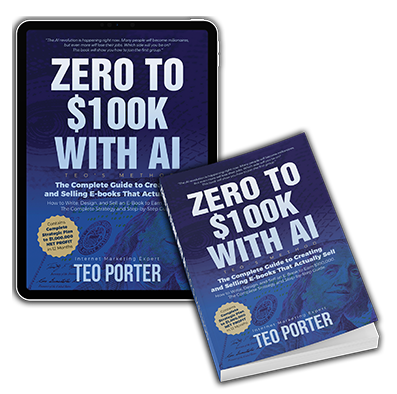
👉 See what’s inside “Zero to $100K with AI. Teo’s Method”
🧱 Day 1 – Turning Your Idea into a Detailed Outline with ChatGPT
Once you’re happy with your idea and working title, it’s time to build the skeleton of your ebook.
This is where most people freeze.
Don’t.
📐 The kind of prompt that gets you a useful outline
You want ChatGPT to behave like a book architect, not a motivational speaker.
For example:"You are an experienced info-product creator and nonfiction editor.
I want to write a paid ebook about: [your idea + working title + who it’s for].
Create a detailed, chapter-by-chapter outline that:
– focuses on getting the reader from [starting point] to [end result],
– includes practical steps, checklists, scripts or templates,
– avoids fluff, theory and generic mindset content,
– can be completed in 40–70 pages of clear writing.
Output the outline with chapter titles, short descriptions, and bullet points for each section.”
You’ll get something that might be 70–80% of the way there.
🔧 Refining the outline so it matches real life
Read the outline with one simple lens:
“Would this actually help someone like my ideal reader change their situation?”
If something feels off:
- Ask ChatGPT to reorder chapters.
- Remove theory-heavy sections.
- Add case-study style chapters or “do this today” checklists.
Treat it like clay, not marble. You’re allowed to reshape it.
✂️ Deciding what to keep, what to cut, and what to expand
A good rule of thumb:
If a section doesn’t directly move the reader closer to the promised result, cut it or shrink it.
Your goal is a structure where each chapter feels like a meaningful step forward. No filler. No “history of X” unless it’s truly necessary.
By the end of Day 1, you want:
- a clear problem,
- a compelling working title,
- and a structured outline you’re not embarrassed by.
That’s enough.
📆 Day 2 – Let ChatGPT Draft the Ebook for You
Sunday is for turning that outline into a real manuscript.
You are not trying to write a literary masterpiece. You’re trying to create a useful, focused guide that someone will happily pay for and actually implement.
🗣️ Prompting ChatGPT to write each section in your voice
The easiest way is to go chapter by chapter.
- Grab the first chapter from your outline.
- Paste it into ChatGPT with a prompt like:
"Using this outline, write the first draft of this chapter.
Write in a friendly, direct tone, like you’re talking to one specific person over coffee.
Use simple language, practical examples, and short paragraphs.
Avoid hype and generic advice, focus on concrete steps and real-world situations.”
- Let it write.
- Read and tweak.
- Repeat for each section.
To keep the voice consistent, you can even feed ChatGPT a sample of your own writing and ask it to model that style.
🧩 Adding your own examples, stories, and experience
This is where the ebook becomes uniquely yours.
ChatGPT can suggest generic examples, but you have:
- your own stories,
- your own mistakes,
- your own little frameworks that grew out of experience.
Sprinkle those in:
- short anecdotes of what you tried that failed,
- screenshots or descriptions of real situations,
- “here’s what I wish someone had told me” sidebars.
Readers feel the difference immediately. It stops feeling like a robot lecture and starts feeling like a human guide.
🧽 Editing for clarity, speed, and usefulness
Once all chapters are drafted:
- Read them in order.
- Cut repetition ruthlessly.
- Simplify sentences where you find yourself getting bored.
- Add subheadings, lists, and call-outs so people can skim.
Ask yourself:
“If someone followed this to the letter, could they actually get the promised result?”
If the honest answer is “yes, with effort,” you’re in great shape.
📊 Case Study: The 52-page PDF that did $96,870
When I created my first AI-assisted ebook, it wasn’t perfect.
The layout was simple. The copy could have been tighter. A designer would probably cry if they saw the first version of the cover.
But it was done. It solved a real problem. It gave people a clear path.
That 52-page PDF, written with the help of AI in under two hours, went on to generate $96,870 in 90 days.
One weekend of focused work turned into a digital asset that sells long after the work was finished.
Inside “Zero to $100K with AI. Teo’s Method”, I break down exactly how I went from blank page to that result: the prompts, the structure, the funnel behind it – everything I wish someone had handed me on day one.
👉 Model the same system with “Zero to $100K with AI. Teo’s Method”
📑 How to Format, Design, and Export Your Ebook (Without Being a Designer)
This is the part that scares people who’ve never opened Canva or any design tool.
It doesn’t need to be complicated.
🛠️ Simple tools to turn your text into a clean PDF
You can:
- draft and format in Google Docs,
- or drop everything into Canva using an ebook/template layout,
- or use a simple document editor that exports nicely to PDF.
Your readers care about clarity, not fancy effects.
🎨 Cover, fonts, and layout that look premium (but are easy)
Stick to:
- one or two clean fonts,
- high contrast (dark text on light background),
- generous spacing,
- a simple, bold cover with your main promise as the headline.
Think “professional and minimal” over “creative and chaotic.”
📖 Making your ebook easy to skim and implement
People love:
- short sections,
- bullets,
- checklists,
- and summaries at the end of each chapter.
Make it easy to jump back in. The more skimmable your ebook is, the more people will actually use it and recommend it.
🧱 Setting Up Simple Sales Infrastructure in a Few Hours
You don’t need a giant tech stack to sell a PDF.
You need three things:
- somewhere to host a sales page,
- a way to take payments,
- and a way to deliver the file automatically.
🖥️ A basic sales page: what it really needs (and what it doesn’t)
Your sales page doesn’t need:
- a brand story that starts in childhood,
- your entire life history,
- 27 different animations.
It does need:
- a clear headline that states the main benefit,
- a short story or context (“why this ebook exists”),
- bullet points of what’s inside,
- who it’s for (and not for),
- proof if you have it (screenshots, testimonials, results),
- a clear price and buy button.
💳 Payment and delivery: getting paid and sending the file automatically
Use any simple combo you like:
- Gumroad, Lemon Squeezy, ThriveCart, WooCommerce, etc.,
- Stripe / PayPal for collecting payments,
- built-in delivery, or a simple “delivery email” automation.
The goal is: you don’t manually send anything. Someone buys, they instantly get:
- a confirmation,
- a download link,
- and maybe a welcome or “read this first” email.
📧 Your first follow-up emails to turn buyers into fans
Even two or three simple emails help:
- “Here’s your ebook + quick start instructions.”
- “Reminder: start here first (most people overcomplicate this).”
- “How to get the most from this ebook + ask for feedback.”
You’re not building a 97-email sequence. You’re just being a decent guide.
🧬 From disconnected pieces to a single method
If all of this feels like a lot of moving parts to figure out alone, you really don’t have to reverse-engineer everything from scratch.
Inside “Zero to $100K with AI. Teo’s Method” you get the whole stack:
- prompts to create your ebook,
- templates for your sales page,
- email sequences,
- and even ad angles for Facebook and Instagram.
Instead of wondering how to connect idea → ebook → page → sales, you follow a single, coherent method from start to finish.
👉 See the full $100K AI ebook blueprint
💵 How to Price Your Ebook So It Actually Sells (and Still Feels Premium)
Pricing triggers all sorts of insecurity. Let’s keep it simple.
🙅♂️ Why underpricing kills motivation and conversions
If you charge $7 for something that could easily be worth $37 or $47:
- you make less money,
- you signal “this probably isn’t that valuable”,
- and you’ll need a LOT more buyers to make your effort feel worth it.
That’s the fastest route to burnout.
🎯 The sweet spot for first-time ebooks
For most first ebooks in a practical niche, a good starting range is:
$19–$47, depending on the depth and problem solved.
Closer to $19 if it’s shorter and solves one small problem.
Closer to $47 if it’s more comprehensive, with templates, scripts, etc.
📈 When and how to raise your price over time
You can always:
- start at a “founding buyers” price,
- gather feedback and testimonials,
- improve the ebook,
- then raise the price as value and proof go up.
Ebooks are not static. You can update, expand, and re-release them.
📋 Weekend Launch Checklist – From Idea to Live Ebook in 48 Hours
Here’s how a realistic “one weekend” flow might look.
📍 Saturday
Morning
- Brainstorm and validate ideas with ChatGPT.
- Choose one problem and working title.
- Generate and refine your outline.
Afternoon
- Draft the first half of the ebook using ChatGPT, plus your own edits and examples.
Evening
- Finish the remaining chapters or get as close as you can.
📍 Sunday
Morning
- Edit the whole manuscript.
- Move it into your design tool (Docs / Canva / etc.).
- Format and export a clean PDF.
Afternoon
- Build a simple sales page.
- Set up payment and automatic delivery.
- Write 2–3 simple follow-up emails.
Evening
- Hit publish.
- Share the page with a few relevant communities, your audience (if you have one), and friends who might know someone it can help.
- Make a list of small tweaks to do next week instead of trying to perfect everything right now.
By Sunday night, you’re no longer “thinking about starting an online business.”
You’ve started one.
📈 What to Expect After Launch (And How to Improve Fast)
Your first version doesn’t need to be perfect. It just needs to exist.
🧪 Why version 1 is allowed to be rough
You’ll learn more from 10 real buyers than from 10 more hours of “planning”.
Some people will:
- ask questions you didn’t answer,
- ask for extra examples,
- or tell you exactly what part helped them most.
That’s gold.
👂 Using early buyers as your best feedback loop
Listen for patterns:
- Questions that keep popping up.
- Sections people say were confusing.
- Wins that people share (“I did this and got X result”).
Use that to:
- update the ebook,
- tighten your sales page,
- improve your emails.
🧪 Simple tweaks that can double or triple conversions
Often it’s not the content that needs fixing first – it’s the framing.
Small things like:
- changing your headline to be more specific,
- adding 1–2 concrete examples to the sales page,
- or clarifying who the ebook is NOT for,
can dramatically improve conversions without changing a word inside the PDF.
🚀 Final Thoughts: One Weekend vs. Another Year of “Thinking About It”
You can absolutely spend the next six months:
- comparing platforms,
- arguing with strangers online about the “best” business model,
- and watching other people post screenshots of Stripe payouts.
Or you can take one weekend, open ChatGPT, follow a clear process, and come out on the other side with:
- a real ebook,
- a real sales page,
- and a realistic shot at building a $10K–$100K income stream over time.
That’s the whole point of this approach: low risk, low complexity, high upside.
AI won’t build your business for you.
But it will happily do 70–80% of the heavy lifting, if you give it direction.
Your job is to supply the judgment, the focus, and the decision to actually start.
🎯 Your Next Move
If you’d like a complete, over-the-shoulder blueprint for this – including the exact prompts, structures, funnels and examples I used to build an AI-powered ebook business up to $100K in revenue – that’s exactly what you’ll find in “Zero to $100K with AI. Teo’s Method.”
But even if you never buy anything from me:
You now have a clear, step-by-step way to use ChatGPT to create a profitable ebook in a single weekend.
The only thing left is the part AI can’t do for you:
choosing to start.






0 Comments